

The 3W Loop™
Where it hurts. Why it happens. Whether the fix works. Most teams have plenty of data and plenty of user feedback, and still ship features nobody uses. The problem is rarely the tools. It is the order in which the questions get asked. The 3W Loop puts them in order: product analytics shows where it hurts, story-based interviews show why it happens, and a scoped experiment shows whether the fix works. The result of the last question is the start of the next loop.
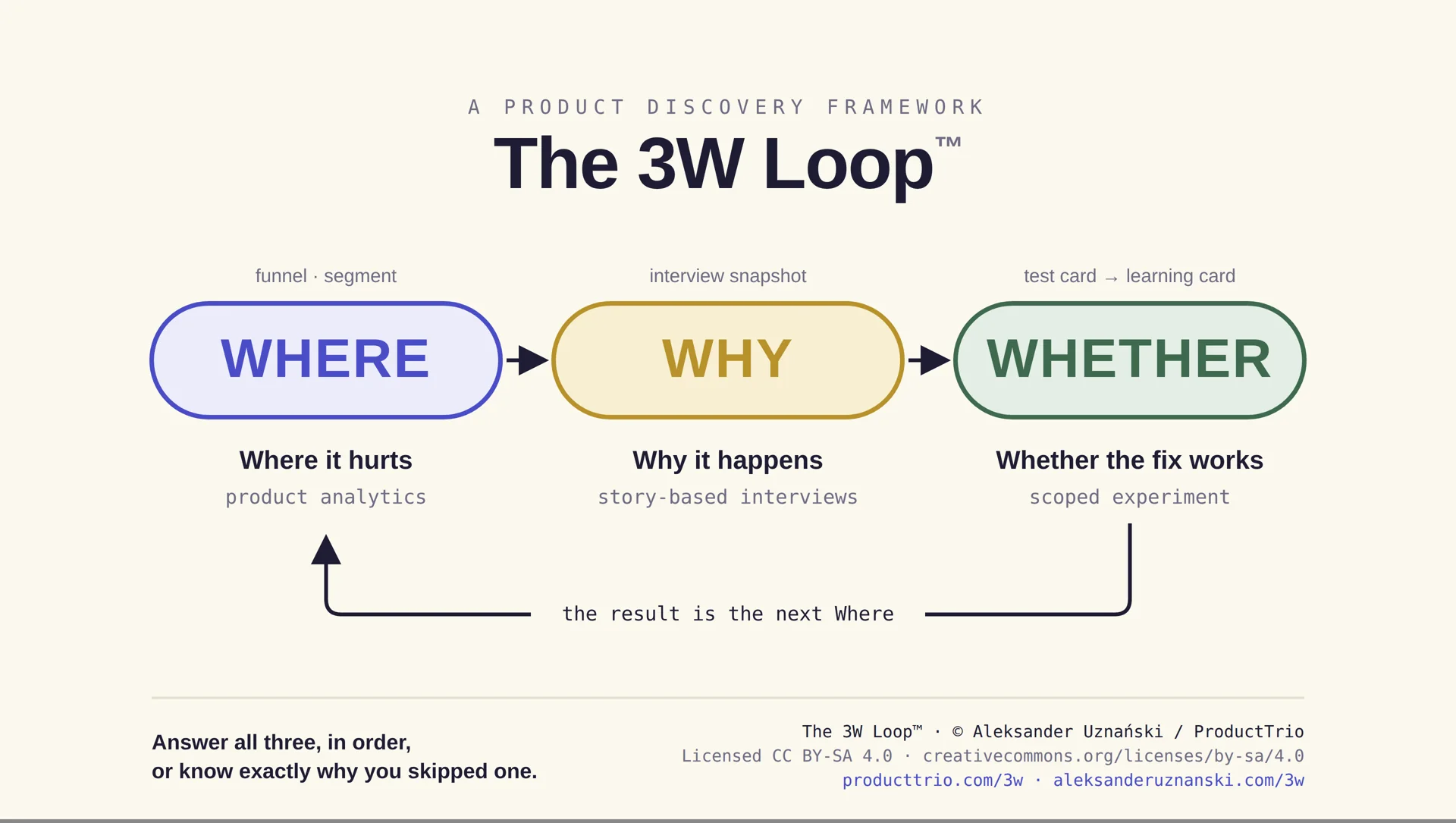
Each question has its own instrument. Most teams answer one and guess the other two.
Where: product analytics
What is broken, for whom, and how badly? A funnel step, a retention cliff, a two-number comparison between segments. Skip it and you get research with no target: interviews about everything, insight about nothing.
Why: story-based interviews
What is actually causing it? Not “would you use...” but “tell me about the last time you...”, asked of the people in that segment. Skip it and you fix the obvious thing for people who were never struggling with it.
Whether: scoped experiment
Does the fix move the number? A test card written before you run it: we believe that, to validate it we will test, we are successful when (a metric and a number, not an adjective), by (a date). Skip it and you ship correlations as features, and never learn what worked.
The order is the whole method
- Ask in order. A Why without a Where is unfocused. A Whether without a Why is a lottery ticket.
- You may skip Why, only when the fix is cheap, reversible, and has one mechanism everyone can name. That is a decision, not an omission.
- You may never skip Whether. A test you cannot fail is a demo.
- Close the loop. The learning card's number is the next Where.
A shared vocabulary, one artifact per step, and a rule for the argument every team has
“We have a Where, we don't have a Why yet” ends a lot of meetings. Each step leaves one thing behind: a funnel or segment comparison, an interview snapshot, a test card and then a learning card. And the question every team fights about, when do we interview and when do we just test, gets a decision rule instead of a debate.
Three checks. Is the fix cheap and reversible? Is there one obvious mechanism? Would you run the test anyway, whatever the interviews said?
Three yeses: test it. Fewer: interview first. Either way, never skip the test. A test you cannot fail is a demo.
Two cases, two routes through the same loop
B2C neobank · onboarding
80% of new users churned on one onboarding screen. Market reports agreed and diagnosed the ID scanner. Story-based interviews with churned users found something else: people were opening the app on the subway and at work, and did not want to pull out their ID in public. The problem was the moment, not the step. A “do it later” option with a reminder at home cut that churn by a quarter.
AI design tool · activation
Users who tried one feature in their first week converted to paid at roughly nine times the rate of those who did not. Here the team skipped interviews on purpose: the mechanism was obvious, the fix was a default toggle, the cost of being wrong was one A/B test. Straight to Whether. Free-to-paid conversion rose.
Same three questions. The skill is knowing which one is actually open.
The framework is free. Take the kit.
The graphic in three formats (PNG, editable SVG, print PDF, light and dark), and the A4 canvas for running the loop on paper with your team. Put it in your decks, teach from it, adapt it. Two conditions: credit, and share-alike for anything you adapt. The licence line is already on the graphic.
Version 1.1, September 2026. The canvas's Whether column now reads as a full test card: we believe that, to validate it we will test, we are successful when (a metric and a number), by (a date). Updated after a workshop round; the graphics are unchanged.
Full framework description, the four rules and the two cases it came from: aleksanderuznanski.com/3w
Every participant takes one real number through all three questions
The 3W Loop Masterclass
Each participant brings one number from your product that hurts or puzzles them, and walks it through all three questions: live interview practice in pairs, a mapped riskiest assumption, and a written test card. Teams leave with three to eight testable bets and the habit of asking the questions in order.
Team workshop
The masterclass plus your real data. We pull the funnel together before the session, so the Where is already on the wall when people arrive, and the afternoon goes into Why and Whether.
Use it, share it, credit it
The 3W Loop graphic, canvas and description are © Aleksander Uznański / ProductTrio and licensed under Creative Commons Attribution-ShareAlike 4.0 International (CC BY-SA 4.0). Copy them, put them in your slides, teach from them, adapt them, use them commercially. Two conditions. Credit like this, next to the graphic or in the notes:
And share-alike: if you adapt it (a redraw, a translation, your own extended version), release the adaptation under the same CC BY-SA 4.0 licence, say it was adapted, and do not suggest that Aleksander endorses your version. Using the graphic unchanged inside your own slides, article or course does not make those materials share-alike. Only the adapted graphic or canvas itself has to stay open. Attribution does not have to sit on the graphic, as long as it is next to it: a caption, a footnote, a line in the speaker notes all work.
The 3W Loop by Aleksander Uznański is licensed under CC BY-SA 4.0


What the licence does not cover. “The 3W Loop” and “Where, Why, Whether” are used as trademarks of Aleksander Uznański / ProductTrio (registration in progress). The licence covers the work, not the name: use the framework and say where it came from, but do not name your own product, course or service “The 3W Loop” or imply it is an official version. The Whether column of the canvas is adapted from Strategyzer's Test Card by Alex Osterwalder, which remains theirs and is not covered by this licence. Workshop decks, run-of-show and case materials are not part of the licence.
Got a number that hurts and no agreed way to chase it?
Book a free intro call and bring the number. We will walk it through Where, Why and Whether in 20 minutes - no pitch deck, just your actual data.
Book a free intro call
.svg)
.svg)
